Publications
Selected publications
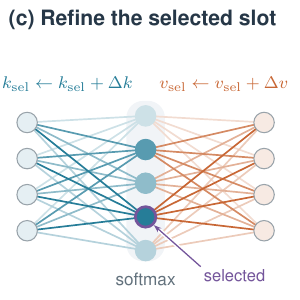
We introduce a recurrent Transformer with learned, sparse updates to a fixed-size key-value memory. Compared with FIFO-based recurrent Transformers, it improves FineWeb language modeling at small memory sizes, learns associative recall faster, and improves needle-in-a-haystack retrieval.
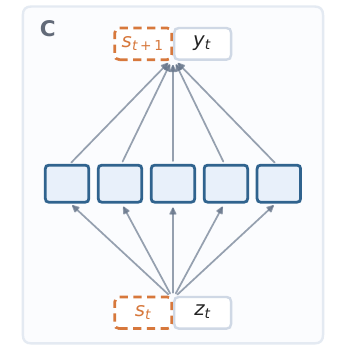
We study how temporal recurrence changes the best allocation of compute along three axes: depth, width, and the number of experts. On Sokoban and FineWeb language modeling, the best observed recurrent models use substantially fewer layers with comparable or better performance under approximately the same per-step compute.
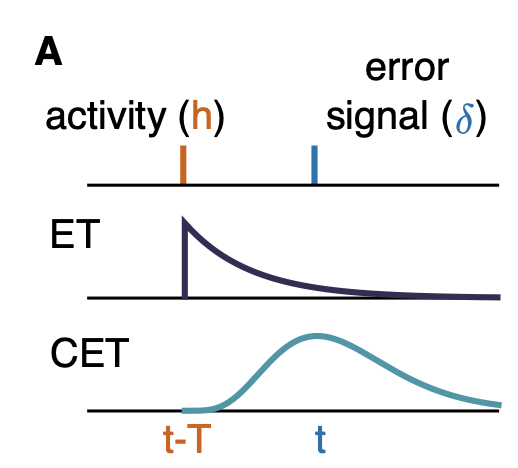
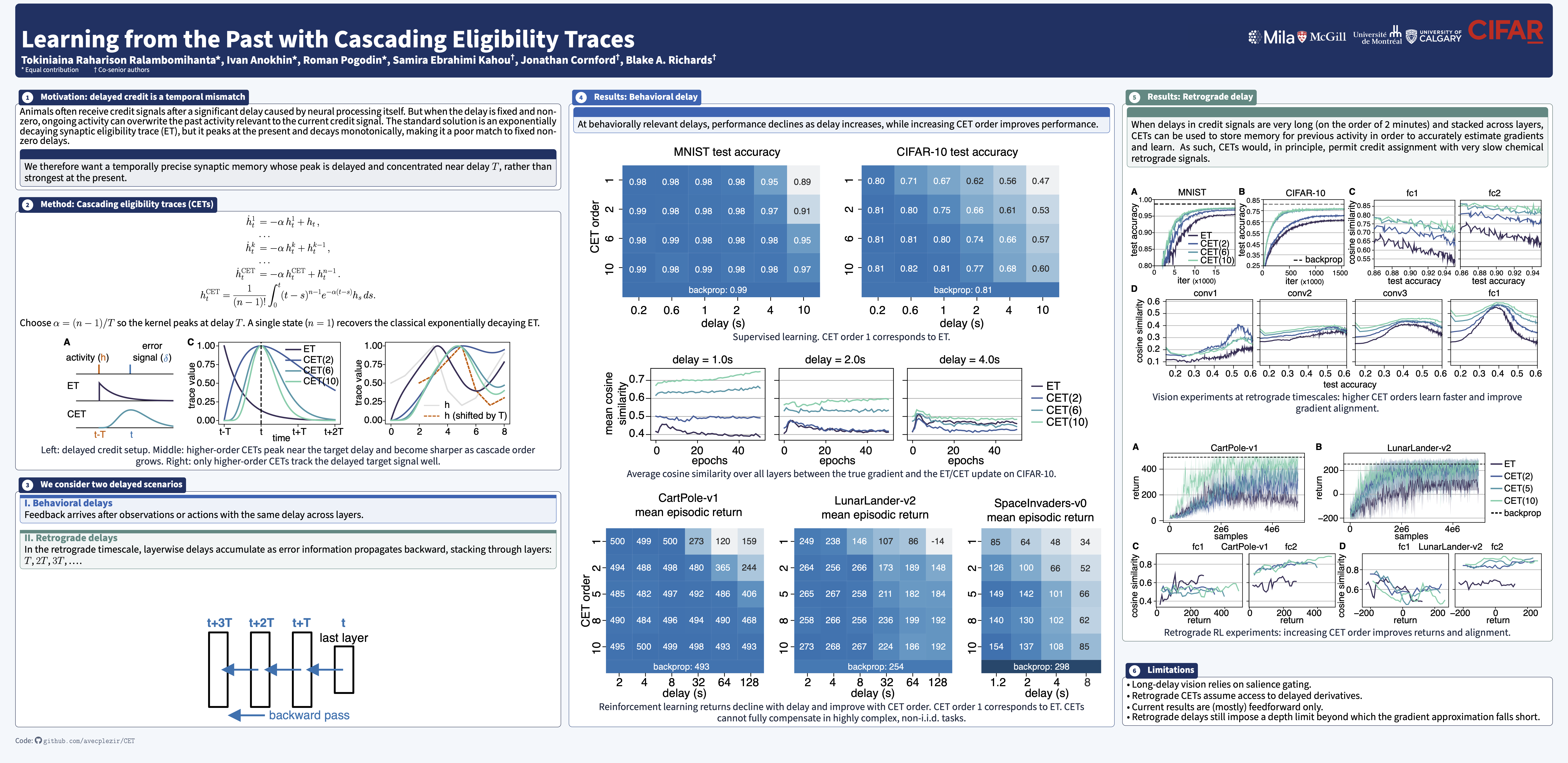
We show how to handle delayed credit assignment in an online, bio-plausible fashion by employing SSMs to retain past activations. We demonstrate the applicability of our method on computer vision and RL tasks. The design is friendly to on-device learning and Streaming RL.
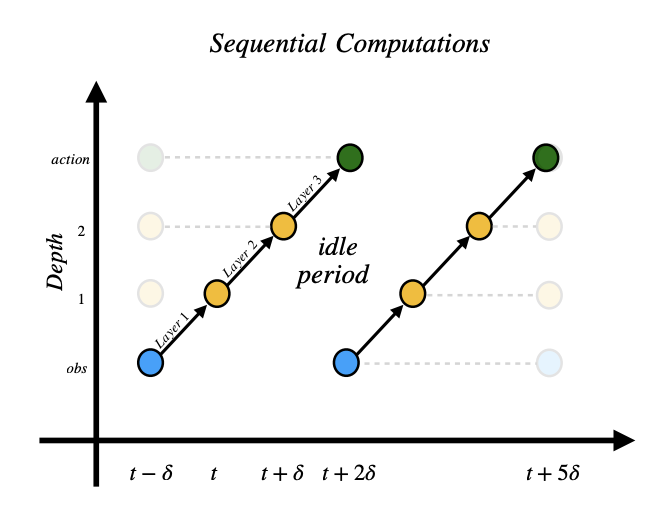
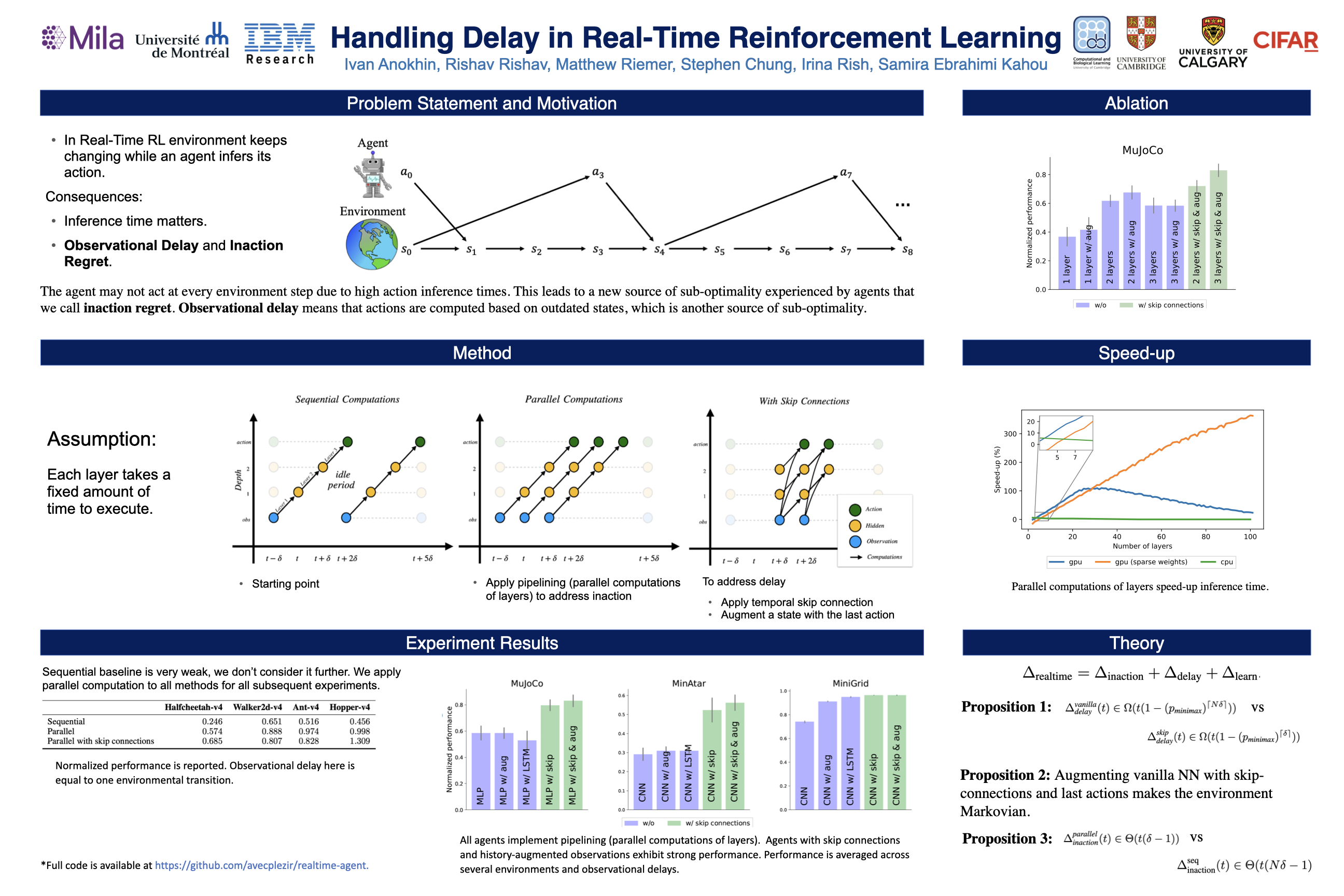
We address real-time RL by pipelining layer computations and handling observation delay. We show it leads to faster inference and competitive performance on MuJoCo and MinAtar. The design is also friendly to on-device inference.
All publications
[1]
I. Anokhin, D. Yasafova, T. Zhao, I. Rish, and S. Risi, “Fast weights recurrent transformer,” in NeurIPS 2026 workshop: Long-context foundation models, 2026.
[2]
I. Anokhin, J. Obando-Ceron, I. Rish, and S. Risi, “Temporal recurrence favors fewer layers,” arXiv preprint arXiv:2609.12531, 2026.
[3]
T. R. Ralambomihanta, I. Anokhin, R. Pogodin, S. E. Kahou, J. Cornford, and B. A. Richards, “Learning from the past with cascading eligibility traces,” arXiv preprint arXiv:2506.14598, 2025.
[4]
J. Chmura et al., “AIF-GEN: Open-source platform and synthetic dataset suite for reinforcement learning on large language models,” in Championing open-source DEvelopment in ML workshop@ ICML25,
[5]
I. Anokhin, R. Rishav, M. Riemer, S. Chung, I. Rish, and S. E. Kahou, “Handling delay in real-time reinforcement learning,” arXiv preprint arXiv:2503.23478, 2025.
[6]
I. Anokhin, R. Rishav, S. Chung, I. Rish, and S. E. Kahou, “Handling delay in reinforcement learning caused by parallel computations of neurons,” in ICML 2024 workshop: Aligning reinforcement learning experimentalists and theorists,
[7]
S. Chung, I. Anokhin, and D. Krueger, “Thinker: Learning to plan and act,” Advances in Neural Information Processing Systems, vol. 36, pp. 22896–22933, 2023.
[8]
M. Velikanov et al., “Embedded ensembles: Infinite width limit and operating regimes,” in International conference on artificial intelligence and statistics, PMLR, 2022, pp. 3138–3163.
[9]
I. Anokhin, K. Demochkin, T. Khakhulin, G. Sterkin, V. Lempitsky, and D. Korzhenkov, “Image generators with conditionally-independent pixel synthesis,” in Proceedings of the IEEE/CVF conference on computer vision and pattern recognition, 2021, pp. 14278–14287.
[10]
I. Anokhin et al., “High-resolution daytime translation without domain labels,” in Proceedings of the IEEE/CVF conference on computer vision and pattern recognition, 2020, pp. 7488–7497.
[11]
I. Anokhin and D. Yarotsky, “Low-loss connection of weight vectors: Distribution-based approaches,” in International conference on machine learning, PMLR, 2020, pp. 335–344.